For your face and neck, squeeze two lines of sunscreen along the full length of your index and middle fingers. That is roughly the amount the SPF on the bottle is tested with, and it is a lot more than most people use. Apply less and you still get some protection, just noticeably less than the number on the label.
The short answer: two finger lengths for face and neck, applied every morning as the last step of your skincare, and topped up every two hours when you are outdoors. Choose a formula you like wearing, because the sunscreen you enjoy is the one you will use generously.
Where the two-finger rule comes from
SPF numbers are measured in the lab with a thick, even layer of 2 milligrams of sunscreen per square centimetre of skin. Nobody measures that at the bathroom sink, so in 2002 two UK researchers, Steve Taylor and Brian Diffey, proposed a practical shortcut in the BMJ. They split the body into areas and worked out that two strips of sunscreen squeezed along the index and middle fingers, from the crease of the palm to the fingertip, gives roughly that 2 mg per square centimetre for one area. The face and neck count as one of those areas, which is where the famous two-finger rule comes from.
The same authors were realistic about people: they suggested that even one finger’s worth would be an improvement, while pointing out that it would give only about half the protection stated on the product. That is the key point I would take away. Under-applying does not switch sunscreen off, but it quietly turns an SPF 50 into something much lower.
If you prefer measuring spoons, most dermatologist guides land somewhere between a quarter and a half teaspoon for the face and neck, depending on the size of your face and how runny the formula is.
What US and UK guidance says
The two countries agree on the basics and differ on the details.
- In the US, the American Academy of Dermatology recommends SPF 30 or higher, broad-spectrum and water-resistant, about 1 ounce (a shot glass) to cover the whole body, around 15 minutes to absorb before going out, and reapplying every two hours and straight after swimming or sweating.
- In the UK, the NHS recommends SPF 30 or higher with at least 4-star UVA protection, around 6 to 8 teaspoons for the entire body, applying it twice (30 minutes before going out and again just before), and reapplying every two hours.
The labels differ too. US sunscreens say “broad spectrum” when they protect against both UVA and UVB. In the UK, look for the UVA star rating on the pack, where more stars mean more UVA protection relative to the SPF, or the UVA circle logo used across Europe.
How to actually get enough on
Knowing the amount is easy. Applying it every day without feeling greasy is the hard part. These habits help:
- Apply it in two thinner layers. Spread one finger’s worth, let it settle for a minute, then add the second. It sinks in better than one thick layer and covers more evenly.
- Put it on last. Sunscreen goes over your moisturizer, as the final step before makeup. The full sequence is in skincare routine order, morning and night.
- Do not forget the edges. Hairline, ears, the sides and back of the neck, and around the eyes are the spots people miss most.
- Pick a texture you like. A fluid or gel finish is easier to use generously if your skin is oily; a creamier formula suits dry skin. Whether it is mineral or chemical matters less than how much you apply; how the two differ is in mineral vs chemical sunscreen.
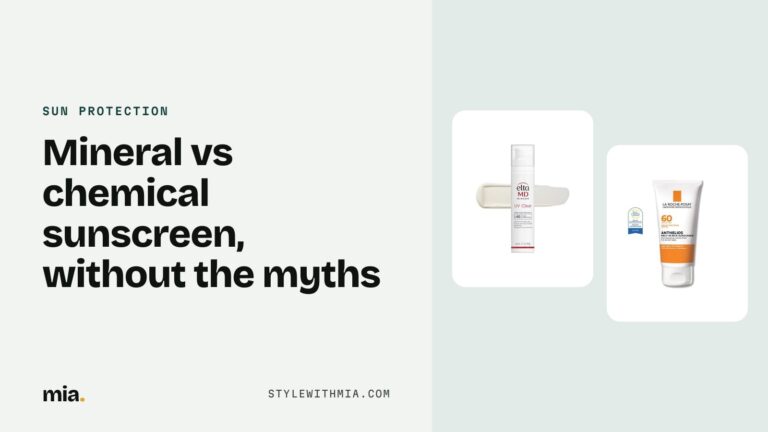
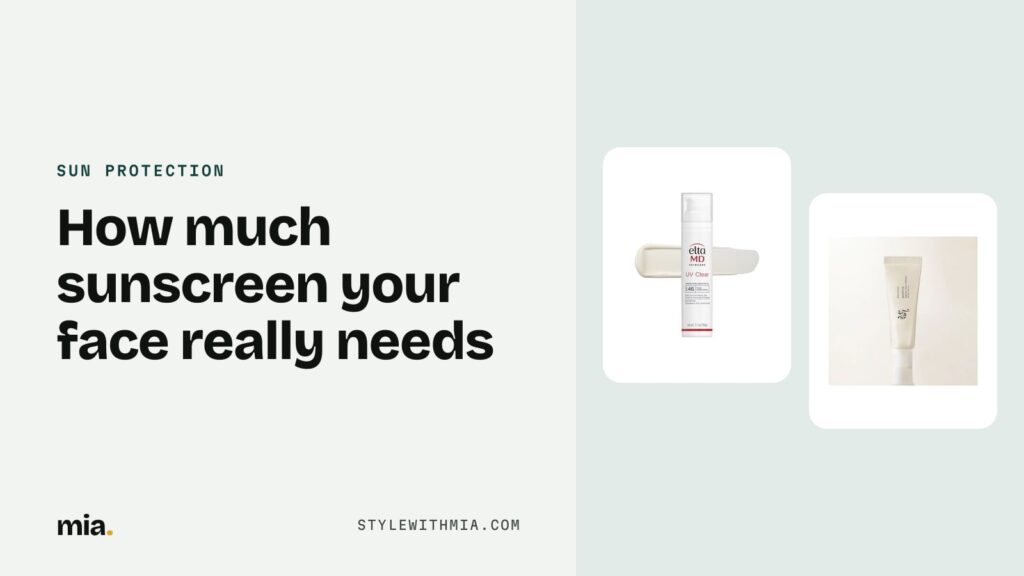
 Zinc oxide 9% · Octinoxate 7.5% · Niacinamide · frag-free · alc-free
EltaMD
UV Clear Broad-Spectrum SPF 46
Zinc oxide 9% · Octinoxate 7.5% · Niacinamide · frag-free · alc-free
EltaMD
UV Clear Broad-Spectrum SPF 46
 Rice extract 30% · Grain-derived probiotics · frag-free · alc-free
Beauty of Joseon
Relief Sun: Rice + Probiotics SPF50+ PA++++
Rice extract 30% · Grain-derived probiotics · frag-free · alc-free
Beauty of Joseon
Relief Sun: Rice + Probiotics SPF50+ PA++++
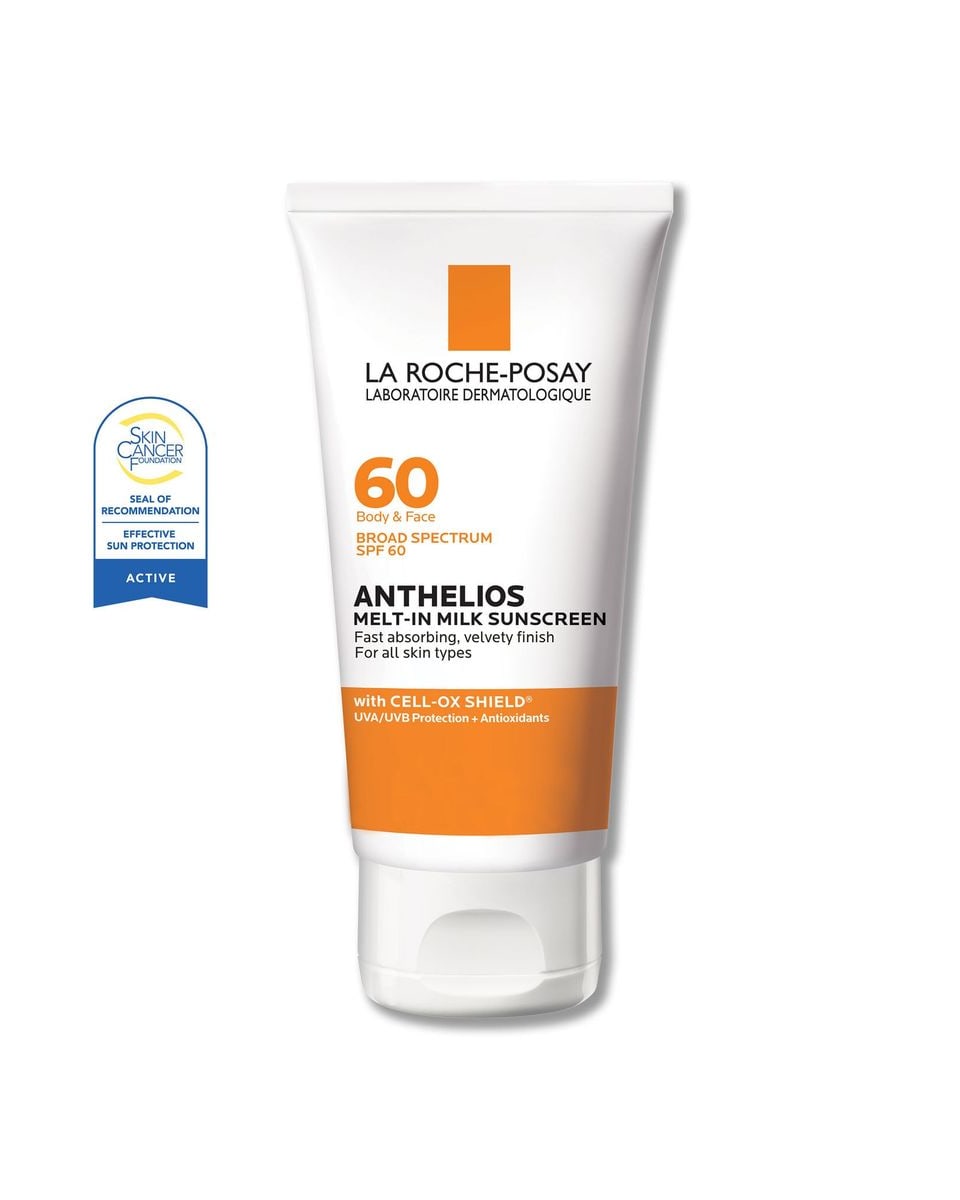 Avobenzone · Homosalate · Octisalate · frag-free · alc-free
La Roche-Posay
Anthelios Melt-In Milk Sunscreen SPF 60
Avobenzone · Homosalate · Octisalate · frag-free · alc-free
La Roche-Posay
Anthelios Melt-In Milk Sunscreen SPF 60
A quick guide to those three: the first is a light formula with zinc oxide and niacinamide, often recommended for oily, acne-prone or sensitive skin; the second is a moisturizing chemical sunscreen that suits dry and normal skin; the third is a high-SPF lotion that works on face and body. You can see every option on the sunscreen shelf.
If you use a retinoid or exfoliating acids, daily sunscreen is not optional, because both leave skin more vulnerable to the sun while it renews. There is more on that in retinol vs adapalene. Daily sunscreen is also the most important step in fading dark spots.
Reapplying over makeup
Reapplication is where good intentions fall apart, especially with makeup on. The options, from most to least protective:
- A sunscreen stick or a fluid pressed on with fingertips. Pat, do not rub, and makeup mostly survives.
- A sunscreen mist, sprayed generously enough to leave the skin visibly damp, then left to dry.
- SPF powder, as a top-up on an ordinary office day. It is hard to apply enough powder to reach the labelled SPF, so treat it as a bonus, not a replacement.
On days spent mostly indoors and away from windows, one generous morning application is what most people realistically manage, and it is far better than a light one. More ideas in the sun protection hub.
Questions people ask
Is the SPF in moisturizer or foundation enough?
Usually not on its own. The SPF on those products is tested at the same heavy dose as sunscreen, and almost nobody applies two finger lengths of foundation. Treat SPF in makeup as extra protection on top of a real sunscreen.
Does a higher SPF mean you can use less?
No. A higher SPF gives more headroom when you under-apply, but thin coverage still lowers the real protection well below the number on the label. Amount first, SPF second.
Do you need sunscreen on cloudy days?
Yes. A lot of UV passes through cloud, which is why people burn on grey days, especially in summer. Daily use is simpler than checking the weather.
How much sunscreen should you use on your face daily?
The same two finger lengths every day you will be outside or near windows for any real length of time. Consistency matters more than any single perfect application.